Monday, January 24, 2011

Why Food is Important in Chinese Medicine

One of the most surprising things to me about studying Chinese Medicine is that it is not the human heart that is the center of the human body universe. It is the spleen and stomach. The spleen and stomach are organs devoted to transforming food and they are number one when looking at your health.

Because of this, food is one of THE vital components that must be studied in Chinese Medicine. After all, it is food that is one of the ingredients to create Qi (chee), the source energy that governs life itself. Organs connected to the creation of Qi are the center of the human body universe in Chinese Medicine.

In Western Medicine, food is looked at like it is a step child in the health care world. It is almost as if it is just a necessary ingredient, but one that is not THAT important. (Have you ever eaten in a hospital cafeteria? You can see what I mean).

Food in Western Medicine is always broken down to calories, carbohydrates, and fats. There may be a bi-line thrown in with the instruction to "eat more greens" as if that is the panacea to cover good nutrition. But overall, it leaves you with an impression that one food can easily be swapped out with another if you know how to substitute the caloric value, or the fats, or the carbohydrates in the equation. For example, you can maybe swap out a spinach salad for a glass of wine and with a bit of tweaking here and there you may even come up with the same caloric value and then call it "good enough".

This concept of food swapping is not part of the Chinese Medicine's health care process.

In Chinese Medicine, EVERYTHING is seen as having value and has a job to do. One would never consider the organs as being expendable and disposable like we do in Western Medicine. In Chinese Medicine, things are just not seen as chemical compositions; everything is part of FLOW and BALANCE.

The way Chinese Medicine uses food and values food is quite the eye opener for me. Just as every organ has value and a job to do, EVERY food has a specific job to do, too. Even different flavors, and even the color of the food, can play different roles in keeping a body healthy. Even the way you prepare the food can impact the body differently. EVERYTHING about the food is important in Chinese Medicine.

This whole concept surrounding food is causing me to pause. I can no longer think that a calorie is a calorie is a calorie because now, every morsel of food can have a different job to do and can have a different responsibility to keep someone healthy. Food is now medicine!

In Chinese Medicine the spleen and stomach are the center of the human body universe, and because of this, food plays one of the most important roles to maintaining someone's health.

Pretty interesting, huh?
Share/Bookmark

Monday, January 17, 2011

Teething Babies, Colic, + Digestion

Gripe Water is the recommended herb for young babies who are teething, according to our instructor. Gripe water contains Xiao Hui Xiang (fennel), ginger, and chamomile. It is used to help teething, colic, and digestive problems in young children.

Xiao Hui Xiang is fennel seed and is known to soothe and warm the digestive track. Sometimes you will see a bowl of fennel at Indian restaurants. Fennel helps move the Qi in the stomach, so next time you see a bowl of it in a restaurant, take a bit and see if it helps relax and soothe your stomach.
Share/Bookmark

Sunday, January 16, 2011

Jing and Goji Berries

Jing is considered one of the vital substances in Chinese Medicine. The vital substances include blood, body fluids, Qi, shen (or mind), and JING.

Jing is considered Essence and is what you inherited from your parents. It regulates the body's growth and development as well as works to protect the body from harmful factors.

The functions of Essence are:
  • growth, reproduction, and development
  • producer of marrow
  • basis of constitutional strength
  • basis for the three treasures - Essence-Qi-Mind
Some say your Essence can not be replenished and you only have what you were born with. Others say it can be replenished, but with difficulty. Goji berries, also known as wolfberries, are a food that some believe may help replace Jing (if it can be replenished). In the USA, goji berries are usually available as dried fruit (around $20/lb...YIKES!!)
Share/Bookmark

Saturday, January 15, 2011

Treating Colds the Chinese Medicine Way

According to Chinese Medicine, colds are considered a wind attack and can quickly move through the body. You can combat the illness head on with some herbal remedies.

Yin Qiao San for the early onset of a soar throat.
  • The formula includes Honeysuckle & Forsythia Powder (san means powder).
  • Dose yourself every two hours at the first signs of cold symptoms.
Zinc
  • Zinc is a good anti-viral
Ren Shen Bai Du San for long-term colds
  • This boots energy and treats the pathogen.
Zhong GenLing for really, really bad colds
  • This is an anti-viral.
Can Cao to regulate the cough (use ONLY if you don't have high blood pressure. Contra-indicated for those with hypertension).

How can you prevent a cold?
  • Get enough sleep.
  • Don't hold onto stress.
  • Get physical exercise.
  • Eat healthy. Refined sugar, which is so prevalent in the American diet, has a direct negative effect on the immune system. It almost eliminates your ability to fight off infection, so don't eat sugar.
  • Vitamin D. Cabbage is good for the immune system. Fermented food is good for the immune system. So eat up!

Share/Bookmark

Sunday, January 2, 2011

Five Elements in Nature - a Foundation in Chinese Medicine

Chinese medicine has existed for about 5,000 years, before CT scans, before X-Rays, before microscopes. Our instructor kept telling us that if we observe and understand nature, we can translate the same principles into Chinese Medicine. He then went on to share the foundation from which the concepts are built on, known as the five elements of nature.

The elements of nature in many cultures are typically the four elements of fire, earth, water, and wood. Aristotle, Hindu, and Buddhism added a fifth esoteric element, the esoteric aether, but in the Chinese culture, metal is the fifth element.

In Chinese culture, the list of natural elements is and their state of constant interaction and flux with one another is the foundation from which everything is built. The different characteristics, correspondences, and inter-relationships in nature uses the exact same principles to assess the body, diagnose problems, and treat diseases. That is why it is so important to have the foundation of understanding how nature works. You will need that same information to know how the body, disease, and treatment works.

This is known as the Cycle of Mutual Promotion of the Five Elements:
  • Water promotes wood.
  • Wood promotes fire.
  • Fire promotes earth (when burning down wood).
  • Earth promotes metal (when burying wood).
  • Metal promotes water (when melted by fire).
This is known as the Cycle of Mutual Control of the Five Elements:
  • Metal controls (chops) wood but controlled by fire.
  • Fire controls metal but controlled by water.
  • Water controls fire but controlled by earth.
  • Earth controls water but controlled by wood.
  • Wood controls earth but controlled by metal.
Here is how these cycles of promotion and control are often depicted:
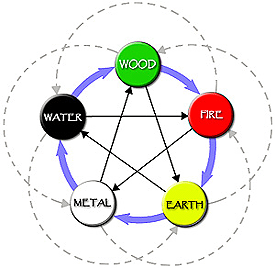
These same characteristics of the five elements in nature, and their affect on each other, is the same paradigm used in the body. Each of the five elements in nature has a major Yin and Yang organ of the body associated with that element.
  • The liver has the same characteristics as wood, growing and unfolding.
  • The heart is the same as fire, warming and flaring up.
  • The spleen is the same as earth, receiving, transforming and generating.
  • The lung is the same as metal, purifying and descending.
  • The kidneys are the same as water, nourishing and flowing downward.
As a result, the organs of the body can now be placed and used in the same cycle of of promotion and control used for the elements in nature:

In summary, the promotion works like this:
  • Kidney (water) promotes liver (wood).
  • Liver (wood) promotes heart (fire).
  • Heart (fire) promotes spleen (earth).
  • Spleen (earth) promotes lung (metal).
  • Lung (metal) promotes kidney (water).
Control of the five vital organs works like this:
  • Lung (metal) controls liver (wood) but controlled by heart (fire).
  • Heart (fire) controls lung (metal) but controlled by kidney (water).
  • Kidney (water) controls heart (fire) but controlled by spleen (earth).
  • Spleen (earth) controls kidney (water) but controlled by liver (wood).
  • Liver (wood) controls spleen (earth) but controlled by lung (metal).
By applying the law of nature to our body system, Chinese medicine can interpret the symptoms and determine the causes of our health problems. When one organ fails, the symptoms usually show up in another. For example, when the lung energy is weak, the liver energy becomes out of control and develops into headaches or high blood pressure. In this case, treating the lungs is necessary in curing liver-related symptoms.

Chinese Medicine also looks at the orifices and openings in a person's face as if they are mirrors to what is going on in the internal vital organs. By observing the orifices and the tissues of the face, the eyes, tongue, mouth, nose, and ears, you can tell what is going on inside a person's organs.

Chinese Medicine also takes into account each season and climate in their assessment and treatment plans. The reason they do this is because each season can have adverse effects on one of our organs. Seasons can also be used to know when to help nurture and store up certain organs to prepare for oncoming seasons and they often prepare for seasons with the use of nutrition. They have determined the five tastes of sour, bitter, sweet, pungent, and salty can have health promotional effects on the five organs and use this as part of their treatment and prevention of disease process.

In addition, Chinese Medicine recognizes emotions can have damaging effects on our vital organs. Too much sadness, for example, damages our lungs. Over joyfulness can cause heart attacks. Extreme anger hurts our livers. Too much worrying causes indigestion. Extreme frightfulness damages our kidneys. Chinese Medicine takes the different emotions and associates them with certain organs and then back to the initial five main elements found in nature.

Here is a summary of what is used in Chinese Medicine and how it translates to the five elements found in nature:


Wood

Fire

Earth

Metal

Water

Yin Organ (Zang)

Liver

Heart

Spleen

Lungs

Kidneys

Yang Organ (Fu)

Gall bladder

Small intestine

Stomach

Large intestine

Bladder

Season

Spring

Summer

Late summer

Autumn

Winter

Climate

Wind

Heat

Dampness

Dryness

Cold

Orifice

Eyes

Tongue

Mouth

Nose

Ears

Tissue

Tendons

Blood vessels

Muscles

Skin

Bones

Taste

Sour

Bitter

Sweet

Pungent

Salty

Emotion

Anger

Joy

Worry

Grief

Fear

So the reason why our instructor says that if you can understand nature and how the five elements work together, you can understand Chinese Medicine. The five elements are the foundation for understanding the inter-workings and thought process used to assess, diagnose, treat, and prevent problems the Chinese Medicine way.
Share/Bookmark

Saturday, January 1, 2011

Bridging Eastern and Western Medicine

Having been trained in Western medicine as a nurse, I am now learning about Eastern medicine by taking acupuncture courses in Chinese Medicine. I am trying to bridge and connect the dots between Eastern and Western medicine and I came across a wonderful book called “Power of the Five Elements”, written by a physician, Dr. Charles A Moss. He also went through a similar process of trying to bridge the concepts together after he embraced acupuncture after becoming a physician.

When the author, Dr. Moss, started to share what changes go on in the brain during an acupuncture treatment, the light went off for me and I thought, "aahhhh...that makes sense!" Here are some excerpts from his book that helped me relate and bridge these two worlds:

“By using MRI and PET scans, researchers have been able to identify the effects on the brain of stress and poor adaptation. The main hormones of the stress response are adrenalin (epinephrine) and cortisol. When a person responds to any long-term stressful situation, they first ramp up production of epinephrine, then cortisol to cope with that life challenge. If the stress continues and they are unable to disengage from that trigger, the elevated cortisol continues and they develop chronic disease and chronic inflammation (heart disease, cancer, autoimmune disease, premature aging. diabetes, obesity). Studies show that people with these problems have lower cortisol than normal.

Cortisol and other stress hormones, which are essential for survival and adaptation, become dangerous when chronically elevated and maladapted. Cortisol imbalance can lead to fatigue, weight gain, immune suppression, and susceptibility to colds, flu, joint pains, mood swings, anxiety, depression, insomnia, and digestive symptoms. These symptoms are a message of poor adaptation. The person needs to learn how to disengage from the stress. This can be done with

Acupuncture reduces the activity in the amygdale and increases the hippocampus activity which is the areas in the brain that control the production of stress hormones and regulate the activity of the adrenal glands. The affect of acupuncture on this part of the brain was the link between the ancient concept of regaining aliveness and newness and improved adoption."


The author also is able to takes the five elements that are used in Chinese Medicine (wood, fire, earth, metal, and water) and uses the information to group people into different buckets or categories of behavior. He goes on to talk about these behaviors as the core to helping these patients "adapt" so they can decrease their cortical levels and become balanced, thereby managing their disease and stress.

Here are the categories of behavior he identifies and associates with the five elements:

WOOD

FIRE

EARTH

METAL

WATER

Expectation

Get my way

True Love

Get needs met

Purify/meaning

Safety

Perception

Blocked

Hurt

Ignored

Dismissed

Danger

Stress Response

Anger/Frustration

Loss of Joy

Search for understanding

Depression

Fear


What I also enjoyed about his method of using the five elements to identify the adaptation behaviors, he also uses that information to identify what type of acupuncture each of those five element types of patients will best respond to, along with meditations and behavior modifications.

The book was helpful to me in starting that bridge between Eastern and Western medicine.

Share/Bookmark

Saturday, December 18, 2010

Food for the Winter Solstice Qi Node

It is the winter solstice which, according to Chinese Medicine, is the time to nourish the Qi (Chi) node. This is the time when Yin energy rules.

At the Da Yuana Circle, I attended a lecture on "Nourishing Within" and these foods, along with the recipes and what they are used for, were shared.

The lunch menu included Fish Miso Soup, Boiled Burdock Root and Toasted Walnuts, and Tofu in Beijing Meat Sauce.

FISH HEAD MISO SOUP
Salmon head is wonderfully yang, nourishing, and easy to digest. The potato guards against toxins. The green freshens up the taste. This soup is good for recovering from surgery.

Stock
3 salmon heads, 1 head celery, 1 medium onion, 2 inch rinsed piece of kombu (kelp), sea salt, black sesame oil.

Preparation
Preheat oven to 400. Rinse fish with cold water. Rub heads with black sesame oil and sea salt. Place in hot oven and roast for 1520 min until very aromatic. Place heads in stockpot with vegetables and water to cover (10 cups)a and bring to boil (uncovered) and reduce by boiling to 8 cups (or pressure cook fro 20-30 minutes) then boil uncovered for 10 mins. Strain.

Ingredients
Fish head stock, peeled potatoes, baby red chard, miso, goji berries, and 2 bunches of green onions (greens only).

Preparation
Soak goji in warm water. Boil potatoes in stock until tender. Wash baby greens. Cut green onions into fine slices. Dilute miso with stock. In war bowl arrange raw greens and cooked potatoes. Add creamed miso. Cover in hot stock.

Serve
Garnish with Green onions and goji.

BOILED BURDOCK ROOT AND TOASTED WALNUTS
Burdock and walnut are very concentrated yang. Chew well and feel the Yang be replenished within.

Ingredients
2 c burdock root cut in matchstick style (julienne), 1 c. shelled walnuts, dressing: ½ tsp each: tamari soy sauce, rice vinegar, and black sesame seed oil

Preparation
Wash and cut burdock. Bring a deep pot of salted acidified water to a rapid boil. Add burdock and return to boil. Cook until tender (25-30 min). Drain burdock and set aside. Heat heavy skillet or fry pan. Wash nuts. Over medium heat, toast nuts in dry pan until aromatic. Chop nuts to fine dice. Mix dressing ingredients with a few drops of hot water. Toss burdock and nuts in dressing.

Serve
Serve room temperature as a side dish (1-2 oz).

TOFU IN BEIJING MEAT SAUCE
Ingredients
3 lbs ground pork, barley malt, thick (black) soy, 1 medium onions, 1/3 c. cooked black soy beans 1-2 squares of firm tofu, light sesame oil, green onion (whites only) fresh gingers.

Preparation
Peel and cut onion into fine dice. Heat pan add oil and sauté onions. Add pork and brown meat. Puree beans with stock or water to thick cream. Once meat is brown, add bean puree, malt, and soy sauce. Stir and let simmer 2-4 hours. Refrigerate over night and reheat. Taste for seasoning (should be a bit sweet). Slice green onions for garnish Cut tofu into cubes and heat up in the sauce. Grate ginger (need 1-2 TB grated ginger) and finish the dish with the juice (squeezed).

Serve
Serve hot or room temp. Garnish with fine slices of green onion whites.
Can serve over rice or noodles.
Share/Bookmark

Friday, December 17, 2010

When the Acupuncture Experience Changes

I have been having acupuncture treatments as a patient and in all of my treatments I have had some pretty amazing experiences, until today. I have been feeling rather healthy lately but am wrapping up the final series of treatments for my lungs. I lay on the table and Pat, the acupuncturist, placed some needs in my arms and legs as well as turned on an electrical current that was connected to what I call a plastic bag that stays nestled between my scapula's.

Pat left the room and I closed my eyes expecting some visuals to take over. They didn’t. Nothing happened. I just lay there with my eyes closed waiting for some sensations to come to life, or some colors to appear, or people to pop in. Nothing happened.

At the end of the treatment, Pat came in and asked about today’s experience. I related how nothing happened. Her response surprised me.

“Just as everything in nature has an ebb and a flow, or a wax and wane, or a yin and yang, it appears you are now in a time of calm. The drama and energy you experienced during your other treatments appears to now have a new look and experience; an opposite. It appears the energy within you is now expressing itself as rest and relaxation. I see this as a very healthy sign."

Her confidence quickly changed my outlook and I immediately concurred with her assessment. Having the experience change is not necessarily a bad thing. Based on Chinese Medicine and it's basis in nature, it is just part of the change in a cycle.

I love acupuncture!
Share/Bookmark

Sunday, December 12, 2010

The Value of Sleep

One third of our life is spent in sleep. Many people try to limit their sleep. Many people use sleep aids to try to help them sleep and lots and lots of people are chronically tired.

Chinese Medicine is very much associated with the cycles of nature. The cycle of the seasons, the moon, and the hours in a day are all significant and contribute to how a person feels as well as their status of health. Because of the longer nights and shorter days during the winter season, there is an awareness of the energy changing not only around a person, but also the energy changes within a person. The Yang energy is lessening right now, and the Yin energy increases. In fact, the peak of Yin energy is at the Winter Solstice.

One of the affects on these changing seasons and change of our internal energy is how it affects our sleep. During this period of time of winter, when the days are shorter and the nights are longer, Chinese Medicine recommends we embrace rest and sleep. In fact, the recommendation would be to go to bed earlier, even as early as 8:00 or 9:00 PM. Why? Because if you allow yourself to give into the natural pull of rest and sleep, you will use that additional time to better regenerate yourself and prepare for what is coming down the road; Spring.

What is regeneration? It is the process of building Qi (or Chi) energy. It is the process of healing. It is the process that allows preparation for what can happen next.

There are 3 cycles of sleep
  • 1st Cycle - the time when you leave and purge the day’s activities or plans for tomorrow
  • 2nd Cycle - the actual sleep where regeneration occurs
  • 3rd Cycle - the time to try and reconnect and wake up
Usually sleep between 1:00 AM – 3:00 AM is the time of actual and deep sleep. Deep sleep is when regeneration happens. You can’t come out of the 2nd cycle of sleep feeling refreshed ; you need to continue on to the 3rd cycle to obtain that feeling of refreshment.

At 3:00 AM, the Yang energy comes back and this is when the shift happens from the 2nd cycle of deep sleep and moves to the 3rd cycle. The 3rd cycle is the time when our cognitive starts to come back.

Many people who have trouble sleeping often rely on sleep aids. According to Chinese Medicine Practitioners, sleep aids (sleeping pills) keep a person in the first cycle of sleep and actually prevent a person from moving through to the 2nd cycle. Because of this, the process of regeneration can not and will not occur. The person taking the sleeping aids will continue to feel unrefreshed, continue to be tired, and may even develop chronic illnesses.

What is the recommendation if you are having trouble sleeping? What should you do?

One recommendation is to take time to focus just on sleep. That means, take some time off work and stay home. Be ready to go to sleep when ever you get tired. What this means is that when you feel tired during the day, you go and take a nap. You do this again and again. You do this for several days until you get refreshed.

What this process does is help you get to the point where you can finally get through to the 2nd and 3rd cycle in the sleep cycle process. By getting to these cycles, you can become refreshed. You finally have gone through the regeneration cycle where your needed energy gets rebuilt.

Why is this necessary? Because it takes energy to be even get to sleep. If you are lacking in that regenerative energy, you don't have energy to help you even transition to sleep. This type of process allows you to build up your energy so you can begin to start going to bed and sleeping normally.

Eventually over time (days or weeks) your body will adjust and your sleep rhythm should adjust to a more natural sleep cycle.

There is a reason why one third of your life is spent in sleep. To be honest, it is probably one of the most valuable parts of your day. Sleep is the time you process and purge your thoughts, which can be seen as a way of cleaning and clearing out the day. It is also the time you regenerate needed energy. It is this needed energy that gives you the power you will need to get through the following day.

This regenerated energy is vital to not only keep you healthy, but also to help you heal. You need this energy to keep you running. If you don't get regenerated, you won't be able to function, or at least not function for very long. Also, if you don't get regenerated, symptoms of chronic illness in other areas of your health will start to emerge.

Sleep is important. It is a natural part of our life. Sleep should not be cut short or discounted because you see it is as unproductive. It is probably one of the most valuable tools you have within you and can help you be in harmony and maintain balance in your life. Sleep helps keep you at your peak.

Sleep is a valuable marker of your overall health and is one of the key indicators in Chinese Medicine to evaluate and assess a persons overall health status.
Share/Bookmark

About Me

My photo
A Quesaksaderak and Medical Qigong Master